Ask what can shorten an automatic transmission's service life, and excessive heat is one important factor—not the only one. When you hitch a travel trailer or equipment flatbed, the engine converts fuel into rotational energy while the transmission channels torque through gears, clutch packs, and hydraulic controls.
Under sustained grades and heavy aerodynamic load, friction and torque-converter operation can add heat to the transmission fluid. Heat can contribute to fluid aging and component wear, but the temperature and exposure at which it becomes a concern vary by transmission, fluid, cooling system, and driving conditions. This guide covers fluid chemistry, dashboard readings, factory and auxiliary cooling, cooler designs, bypass controls, engine oil, and monitoring equipment.
1. The Chemistry of Destruction: The Arrhenius Rule of ATF
Automatic transmission fluid (ATF) is a specialized fluid. In an automatic transmission it can provide hydraulic control, lubrication, friction characteristics, and heat transfer. Its formulation is specific to the transmission and should match the fluid specification in the owner's manual.
The Arrhenius equation describes how temperature can affect chemical reaction rates, including oxidation. It does not by itself establish one universal rule that fluid life is cut in half at a fixed temperature increase, or provide a reliable mileage prediction for every fluid and transmission. Actual fluid life depends on formulation, time and load at temperature, contamination, transmission design, and maintenance.
What can happen when ATF is exposed to excessive heat?
- Heat exposure over time can accelerate fluid oxidation and reduce the effectiveness of some additives.
- Degraded fluid and deposits can affect hydraulic passages, seals, clutch materials, or shift quality, depending on the transmission and condition.
- There is no single temperature threshold that predicts the same damage or remaining service life in every transmission.
| What affects ATF service life | Why a universal mileage table does not fit | Use instead |
|---|---|---|
| Fluid specification and transmission design | Fluids and operating limits differ | The exact OEM fluid specification |
| Time, load, temperature, and contamination | One temperature reading does not describe total exposure | The applicable owner's-manual service schedule |
| Towing and other severe-use conditions | Service intervals depend on the vehicle and use | The OEM severe-duty schedule, when applicable |
Heat can speed fluid oxidation, but avoid turning a general chemistry model into an exact replacement interval. Ford's 2025 towing guide directs owners to the specific vehicle manual for severe-duty maintenance guidance.
2. Normal Transmission Temperatures Towing: Benchmarking the Dashboard
A dashboard reading is useful only when interpreted for the vehicle that produced it. The sensor may measure fluid at a particular location in the transmission or cooling circuit, and displays and warning thresholds are manufacturer-specific. A reading from one model is not a universal normal, elevated, or danger limit for another.
| Situation | How to interpret it | What to do |
|---|---|---|
| Cold start or warm-up | Warm-up behavior differs by transmission and conditions | Follow the manual for cold-weather operation |
| Sustained climb or heavy towing | Load, grade, speed, airflow, and ambient conditions affect readings | Monitor the vehicle's gauges and warnings |
| Over-temperature warning or abnormal behavior | A warning, marked power loss, or unusual noise needs attention | Get to a safe place and follow that vehicle's instructions |
Chevrolet's 2026 Trailering Guide warns that prolonged driving with overheated fluids can cause damage and gives steps for the vehicles covered by that guide. Those steps should not be applied to every make and model; use the exact owner's manual.
3. The Cooling Stack: Factory In-Radiator Exchanger vs. Auxiliary Coolers
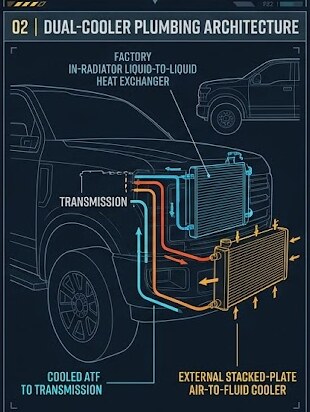
Factory transmission-cooling layouts differ. Some vehicles use a liquid-to-liquid heat exchanger connected to engine coolant; others use an air-to-fluid cooler or combine cooling elements. Towing packages may change the equipment, so check the exact engine, transmission, model year, and package.
The factory in-tank heat exchanger
In some vehicles, transmission fluid passes through an exchanger connected to the engine cooling system. Depending on relative temperatures and system design, it can transfer heat to or from the fluid. The effect is not a universal minimum temperature, and it does not mean every factory system is inadequate for towing.
The cooling challenge under heavy towing
On a long climb or in hot weather, several parts of the cooling system may be working under sustained load. If the fluid and coolant temperatures are close, a coolant-to-fluid exchanger may have less temperature difference available for heat transfer. Actual behavior depends on the vehicle, cooling circuit, airflow, and operating conditions.
A secondary air-to-fluid cooler
An auxiliary cooler is an additional heat exchanger exposed to airflow. It may add heat-rejection capacity in an approved application, but the result depends on its design, installation, airflow, ambient conditions, and the rest of the vehicle's cooling circuit. A generic temperature-drop estimate is not a fitment guarantee.
Some cooler products are designed to work in series with the original-equipment cooler. NAPA Temp's technical note says that is how its listed applications are rated; this is product-specific guidance, not a universal instruction for every vehicle or cooler.
4. Auxiliary Cooler Designs: Tube-and-Fin vs. Stacked-Plate
Cooler construction is one factor in heat transfer, packaging, and fluid-flow resistance. The design name alone does not establish capacity, pressure drop, puncture resistance, or suitability for a particular trailer weight. Compare manufacturer specifications for the exact cooler and vehicle application.
| Design | General construction | What to verify |
|---|---|---|
| Tube-and-fin | Fluid travels through tubing with attached fins | Application, flow requirements, mounting, and protection |
| Plate-and-fin | Flat passages and fins form the heat-exchange core | Published performance and pressure specifications |
| Stacked-plate | Multiple plates create fluid passages and air-side surface area | Exact fitment, line routing, pressure limits, and airflow |
There is no universal cooler-size or trailer-weight chart that applies to every transmission. Use vehicle-maker recommendations and the cooler manufacturer's specifications rather than choosing by a generic “heavy-duty” label.
5. The Overcooling Trap: Why Bypass Design Matters
“The colder, the better” is not a safe rule for every transmission. Fluid viscosity changes with temperature, and the vehicle's thermal management is designed around its specific transmission and cooling circuit. Some applications use an OEM thermal valve or a cooler-kit bypass; others use different arrangements.
Before adding a bypass valve
- Check whether the vehicle already has a factory thermal-management valve.
- Follow the cooler kit instructions for compatible bypass parts and routing.
- Do not apply one universal opening temperature or valve design to every system.
- Ask a qualified installer if the factory and aftermarket instructions differ.
The illustration shows one bypass concept, but its particular valve style and temperature values are not requirements for all vehicles. The correct design and operating range are application-specific.
When a thermostatic bypass is used, it controls whether fluid flows through the cooler or follows a bypass path according to that system's design. The correct valve, routing, and opening range are specified by the vehicle or cooler manufacturer—not by one universal H-pattern design or temperature pair.
6. Engine Oil Coolers: Managing the Sibling Thermal Load
Engine oil does more than lubricate moving parts: some engine designs use oil to carry heat away from pistons or turbocharger bearings. The exact cooling arrangements and temperatures depend on the engine and its operating conditions.
There is no single engine-oil temperature or fixed difference from coolant temperature that applies to every towing vehicle. Oil grade, temperature limits, and maintenance intervals should come from the specific owner's manual. A general temperature chart is not enough to diagnose a need for an aftermarket oil cooler.
Liquid-to-liquid and air-to-oil designs
Some factory systems exchange heat between engine oil and coolant; separate air-to-oil coolers are also used in certain applications. Whether an additional cooler, thermostat, or special plumbing is appropriate depends on the engine and vehicle-maker guidance. Do not add one based on a generic temperature drop or thermostat setting.
7. Essential Thermal-Management Hardware
If you regularly tow heavy loads, first confirm the factory equipment and maintenance requirements for your vehicle. Hardware choices should follow approved fitment and current manufacturer specifications.
Auxiliary coolers
Verify vehicle fitment, fluid-flow and pressure requirements, cooler placement, airflow, and whether the kit requires a bypass. Product ratings and installation directions are specific to the model and application.
Deep cast-aluminum transmission pans
Some replacement pans change fluid capacity or add external surface area, but the effect depends on the pan and transmission. Confirm fit, clearance, fluid level procedure, and compatibility; a pan does not change the vehicle's weight ratings.
Real-time digital temperature monitors
Factory displays and aftermarket monitors can present data differently. An OBD monitor can show only the parameters that the vehicle exposes and the device supports; readings depend on the sensor and data source. Check compatibility and use the owner's manual to interpret warnings.
Product specifications, availability, and vehicle fitment vary. Confirm current details for the exact vehicle; this guide does not rank or recommend a particular product.
Practical takeaway
Keep the original principle in view: managing heat matters when towing. But exact temperature bands, fluid-life mileage, cooler sizes, bypass settings, and engine-oil recommendations are not universal. Use the service schedule and equipment guidance for your vehicle, and treat a warning or recurring high reading as a reason to follow the manufacturer's diagnostic instructions.
For related guidance, see how Tow/Haul mode works and the towing data dictionary.